

How Utopai Studios Became the World's Largest Independent AI-Native Film and Television Studio in Just One Year
(NewsUSA) - With 25 original projects in development and three films and two series set for 2027, Utopai Studios is pairing human-led filmmaking with AI-native production infrastructure to build a new global entertainment studio.
When Utopai Studios launched in August 2025, generative AI's role in entertainment was still largely defined by individual clips, technical demonstrations and short-form experiments. The company entered the market with a far more ambitious proposition: to build an entire film and television studio for the AI era.
Just over a year later, Utopai Studios has become what Variety described as the world's largest independent AI-native film and television studio, and Forbes estimates its valuation at $1 billion. Utopai Studios now has 25 original projects in various stages of development and production, a growing network of international partners and three feature films and two series scheduled for 2027.That rapid growth did not come from treating AI as the finished product. Utopai Studios has built its model around the infrastructure required to develop, finance, produce and distribute long-form entertainment, combining filmmakers, artists and established production practices with technology designed to help bring ambitious stories to the screen.
AI-native, in the Utopai Studios model, does not mean turning creative decisions over to technology. It means AI is integrated into the studio's production infrastructure from the beginning, allowing filmmakers and artists to determine where it can be useful while retaining control over story, style, performance and final creative decisions.
A Studio Built for Long-Form Storytelling
Utopai Studios develops, finances, produces and distributes movies and television series, including original productions and international co-productions. Led by CEO and co-founder Cecilia Shen and co-founder and Chief Technology Officer Jie Yang, the company combines creative talent, production expertise and global distribution with technology developed for the demands of sustained storytelling.
At the center of that production strategy is PAI, Utopai Studios' cinematic storytelling system. Depending on the needs of a project, PAI can support visual development, scene planning, continuity, video generation, editing and localization. It is designed to work alongside established filmmaking tools and traditional creative methods, not as a substitute for them.
The distinction matters. Much of generative AI's first wave in entertainment was defined by individual clips, technical demonstrations and short-form experiments. Utopai Studios is focused on the more difficult challenge of carrying characters, worlds and creative intent across complete films and television series, then bringing those projects to audiences across theatrical, broadcast, streaming and digital platforms.
A Global Production Network
Utopai Studios is applying its model through relationships with established entertainment companies in Asia and other major markets. Its customers and collaborators include Huace Film & TV Co., Ltd. in China and DeNA Co., Ltd. in Japan, giving the company real-world environments in which to develop and refine AI-enabled production workflows.Utopai Studios is developing more than 18 original projects in Asia. In April, the company announced a partnership with Huace, which owns one of the world's largest television IP libraries. The work is intended to support long-form storytelling, content development, creative iteration, and global localization, and includes the companies' animated series "Journey to the West: The Lost Five Hundred Years."
Three Films and Two Series in 2027
Utopai Studios' 2027 lineup includes three feature films, "Half Moon," "Cortés" and "The Most Serious Fart," along with the series "Space Nation" and "Journey to the West: The Lost Five Hundred Years." Together, the five projects demonstrate that AI-native production is not a single visual style or production formula.
Half Moon
"Half Moon" shows how Utopai Studios can use AI selectively within a live-action production. Written and directed by Hyo-joo Yang, the feature is presented by Utopai Studios, Germany's In Good Company and Korea's Paper Barn Studios. Principal photography began in Germany in August 2026, with PAI supporting select visual elements while the film remains grounded in live-action performances, director-led storytelling and traditional cinematic craft.
The film follows Yeri, a young girl neglected at home, and her aunt Ah-Jin, who lives in self-imposed exile and works as a caregiver while carrying the physical and psychological wounds of her past. During a fractured summer on a remote island in the North Sea, the estranged family members begin to understand and respect one another. The story explores loneliness, family trauma, belonging and emotional repair.
Cortés
Utopai Studios is especially enthusiastic about one of its first announced projects: “Cortés.” Set in 1519, the historical epic follows Hernán Cortés during the Spanish conquest of the Aztec Empire.
“Cortés” is a Marco Weber Production for Utopai Studios and is written by Oscar-nominated screenwriter Nicholas Kazan and directed by Paul Mignot. It is a Paris-based production with shooting planned for September in Spain. “Cortés” is scheduled for a wide theatrical release in 2027.
The project represents a decades-long effort to bring an unusually large and expensive historical story to life. Utopai Studios will use AI-enabled production tools to help overcome the scale and cost limitations that previously kept the project from the screen, while keeping the filmmakers in control of the creative process.
The Most Serious Fart
 Scheduled for wide theatrical release in 2027, "The Most Serious Fart" is based on the 2023 children's book by Mike Bender, the screenwriter behind "Not Another Teen Movie," and illustrator Chuck Dillon. Bender will write and direct the animated feature, with Russell Hollander producing.
The story follows Siegfried, an unusually serious fart who wants to change society's perception of flatulence while searching for a sense of belonging. Beneath the irreverent premise is a story about identity, acceptance and finding one's place in the world. Traditional filmmaking craft and artists remain central, from production design and storyboarding through animation, with AI used as part of the human-led creative process.
Space Nation
“Space Nation,” an eight-episode sci-fi series being produced by Ex Machina Studios, is one of the first AI productions to be picked up by a traditional buyer, including Brazil’s Globoplay. Set in the near future, the story follows a new generation of elite pilots as they defend Earth against an alien threat.
Marco Weber, CEO of Ex Machina Studios, co-created the series with Martin Weisz, who is directing all eight episodes. Vanessa Coifman and Weisz wrote the series, with Weber and Coifman executive producing. The series is being co-produced by Utopai Studios and Globoplay.
Principal production is already underway and is expected to take place in alignment with Hollywood guilds. “Space Nation” is part of Ex Machina Studios’ broader partnership with K5 International, which is handling worldwide distribution.
Journey to the West: The Lost Five Hundred Years
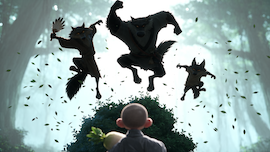 Developed with Huace, "Journey to the West: The Lost Five Hundred Years" takes a more fully AI-generated approach to animation. Inspired by the classic Chinese novel, the series reimagines the untold history of Sun Wukong, the Monkey King, and explores why the rebellious warrior and immortal force of nature would ultimately become the protector of a monk he had never met.
The project is being produced for broadcast, streaming and digital distribution, with the potential for a theatrical version. Utopai Studios controls the rights outside China, creating a path for the story to reach global audiences.
One Studio, Multiple Production Models
Across the slate, Utopai Studios is making a broader point: AI-native storytelling does not require every project to be made the same way. On "Half Moon," AI supports selected visual elements inside a live-action workflow. On "Cortés," it is intended to help filmmakers realize the scale of a historical epic. "The Most Serious Fart" pairs AI with traditional animation disciplines, while "Journey to the West" uses a more fully AI-generated animation pipeline.
Utopai Studios has also extended its entertainment ecosystem through sports and creator partnerships. Basketball star Carmelo Anthony invested through Creative 7 Productions and became a strategic partner, while James Harden collaborated with Utopai Studios on an animated short inspired by his famous beard. Those relationships connect the studio's technology with intellectual property, talent and new production opportunities.
The 2027 slate will be the company's most important proof point. At a moment when the conversation around generative AI has been dominated by what the technology might eventually do, Utopai Studios is betting that the next phase will be defined by finished films and television series: human-led, built for audiences and ambitious enough to stand on their own as entertainment.