
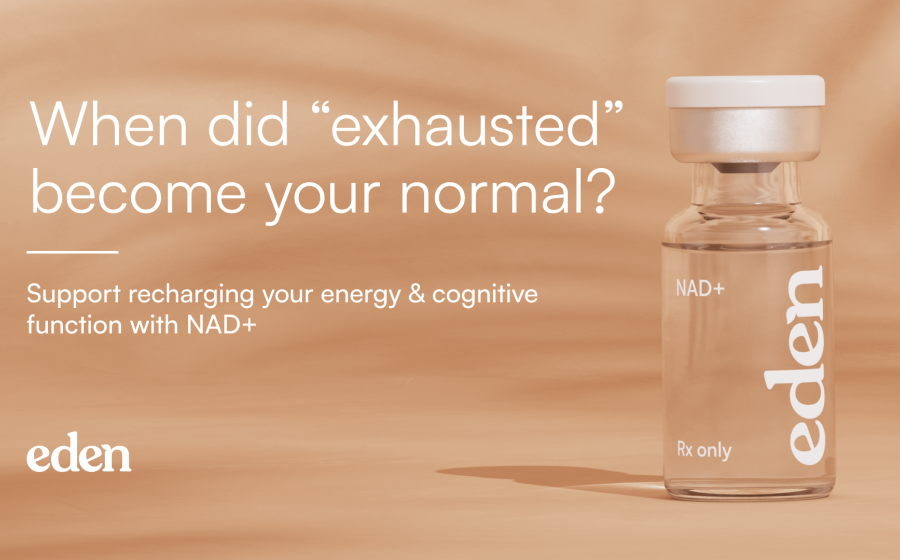
Eden's NAD⁺ Program Sparks New Conversations on Aging and Longevity
(Madison Roberts, Contributor) - It might sound like science fiction: a molecule already inside your body holds the potential to slow the aging process, sharpen the mind, and energize the body. Yet in the ever-evolving frontier of longevity research, NAD⁺ a coenzyme found in every living cell, is emerging as one of the most talked-about elements in the science of aging.
At the intersection of this conversation is Eden, a fast-growing health platform that’s betting big on the future of metabolic wellness. Their latest offering? Facilitated access to NAD⁺ injection programs via online consultations with licensed medical providers.
It’s not a miracle cure, far from it. But Eden is positioning itself as a leader in democratizing access to emerging longevity therapies. And that, in itself, is a story worth watching.
The Molecule Behind the Hype: What Is NAD⁺?Nicotinamide adenine dinucleotide, or NAD⁺, may not be a household name yet. But within the cells of your body, it plays a starring role in essential functions: converting food into energy, supporting mitochondrial health, repairing DNA, and regulating cellular stress responses.
The problem? NAD⁺ levels decline sharply with age.
This natural drop-off has been linked in early studies to fatigue, cognitive sluggishness, and decreased physical resilience. Which is why researchers have spent the last decade looking into whether restoring NAD⁺ levels often using precursors like NMN or NR could enhance quality of life as we age.
In a 2022 human clinical trial published in NPJ Aging, older men supplemented with NMN showed measurable improvements in muscle strength and gait speed over 12 weeks. Other animal studies suggest NAD⁺ precursors might improve memory, slow vascular aging, and even boost circadian rhythm in aging mice.
These findings are far from conclusive, but they’ve sparked a wave of interest from both scientists and consumers eager to better understand the biology of aging.
The Eden Model: From Longevity Theory to Personalized WellnessEden doesn’t develop treatments, prescribe medications, or claim to reverse aging. What it does is enable people to consult with licensed medical providers who are fluent in emerging metabolic health strategies, including NAD⁺ protocols. It’s a modern, tech-enabled version of personalized wellness.
“People want more than the status quo, they want smarter, proactive conversations about their health,” said Josh Khan, Eden’s President and Co-Founder. “That’s what we’re here to support: evidence-based access, not hype.”
Starting at $189 per month, Eden’s NAD⁺ program connects users with licensed clinicians for one-on-one consultations. If NAD⁺ therapy is deemed appropriate, patients receive a personalized plan, and prescriptions are filled by licensed compounding pharmacies.
For Adam McBride, Eden’s CEO and Co-Founder, the NAD⁺ program reflects a broader philosophy.
“Our approach isn’t about chasing fads,” McBride told me. “It’s about grounding care in real science, giving people access to professionals who can help them navigate what’s possible, what’s proven, and what still needs more data.”
Enter Dr. Halland Chen, MD: The Longevity Doctor Joins EdenEarlier this month, Eden made a headline-grabbing hire that signaled just how serious it is about longevity. Dr. Halland Chen, MD, a double board-certified physician with deep roots in regenerative and functional medicine joined the company as Chief Medical Innovation Officer.
Dr. Halland is no stranger to the spotlight. Known in elite wellness circles as “The Longevity Doctor,” his work spans regenerative medicine, IV NAD⁺ infusions, and personalized anti-aging protocols.
“I’m really excited to be working with Eden to rethink how people approach metabolic health,” Dr. Halland said. “There’s enormous potential in combining regenerative medicine, functional strategies, and personalized data. The future of wellness isn’t one-size-fits-all, it’s precision-guided.”
Dr. Halland’s appointment brings Eden closer to the growing field of personalized medicine, where genetics, lifestyle, and biology are combined to develop tailored health plans. His clinical experience, paired with Eden’s digital infrastructure, offers a compelling model for what aging care could look like in the next decade.
The Science: Promising, but Still EvolvingSo what can NAD⁺ actually do? The scientific community is cautiously optimistic.
In recent years, multiple studies have hinted at a wide range of potential benefits, from enhanced mitochondrial function and muscle endurance to improved cognition and sleep quality. In one of the most cited animal studies, aged mice given NMN showed increased capillary density and endurance levels comparable to younger mice, suggesting a reversal of age-related vascular decline.
Human trials, though still limited, are beginning to echo some of these results. A placebo-controlled study in postmenopausal women found that NR (a NAD⁺ precursor) increased NAD⁺ levels and showed signs of reduced liver fat, a promising biomarker for metabolic improvement.
Yet experts are quick to point out that NAD⁺ therapy remains investigational. Much of the most exciting research is still in the preclinical or early human trial phase. While the potential is there, the proof is still being built.
“We’re not promising miracles,” said Dr. Halland. “But we are helping people engage with the latest science in a responsible, informed way.”
Redefining Aging: From Lifespan to HealthspanThe promise of NAD⁺ isn’t about living forever. It’s about living better.
“What people are really looking for isn’t more years, it’s better years,” McBride said. “If NAD⁺ turns out to be one tool that helps people feel sharper, move more easily, or recover faster as they age, that’s meaningful.”
For Eden, the NAD⁺ program is part of a larger trend: a shift away from reactive medicine and toward proactive wellness. The platform now supports provider-guided care for whole body health, all tailored to the individual.
“Longevity isn’t about avoiding death,” added Dr. Halland. “It’s about maximizing life physically, mentally, emotionally. NAD⁺ is one part of that story. And we’re just getting started.”
The Bottom LineAging isn’t what it used to be. And neither is healthcare.
With its NAD⁺ injection program, Eden isn’t offering a silver bullet, but it is offering something that’s become increasingly rare in modern medicine: access to timely, evolving science delivered through a human conversation.
Whether NAD⁺ ultimately becomes a foundational tool in the longevity toolkit remains to be seen. But for now, Eden’s model, equal parts access, innovation, and restraint, may be one of the most compelling developments in the wellness world today.

 - Spring is the season of fresh starts and new beginnings. As it draws to a close and we head into summer, we are taking a look at how the millions of Americans living with diabetes can use the change in season to kickstart better habits or try something new.
 - More than two-thirds of U.S. adults say they would rather file their taxes than get a colonoscopy, according to data from a new survey commissioned by the
 - More than 100,000 Americans have said goodbye to their common skin cancer without requiring surgery, owing to a relatively new noninvasive treatment available at many dermatology practices around the nation.
 - Troy Ita’s life was turned upside down by diabetes. Thankfully, he doesn’t have to compromise lifestyle or family time with the help of groundbreaking technology.
 -
-  If you put on socks this morning but skipped the sunscreen, you’re doing it wrong — at least according to a new nationwide campaign launched on World Health Day earlier this spring.
 - As the cold of winter fades, spring brings a fresh sense of renewal—and for many, it’s the first time in months they’ll be showing off their legs again. But for some, the thought of revealing their legs can come with hesitation. This may be especially true for those with varicose veins.
 - As the cold of winter fades, spring brings a fresh sense of renewal—and for many, it’s the first time in months they’ll be showing off their legs again. But for some, the thought of revealing their legs can come with hesitation. This may be especially true for those with varicose veins.
 - The newest generation of GLP-1 drugs has delivered life-changing benefits to patients managing diabetes, obesity, heart disease, and other chronic health conditions. And yet even though
 - As the cold of winter fades, spring brings a fresh sense of renewal—and for many, it’s the first time in months they’ll be showing off their legs again. But for some, the thought of revealing their legs can come with hesitation. This may be especially true for those with varicose veins.