x

Interview with Jane Carson, Growth Manager, Santiago Ways

Interview with Jane Carson, Growth Manager, Santiago Ways

(Featured) - Carson explains why American pilgrims value private rooms, luggage transfers and support, and how route choices can benefit local communities.

Edited by Haley Spracale, Editor at Featured News · Nov 17, 2026

As a Growth Manager with experience in growth strategy, customer acquisition, and hospitality-focused marketing, what perspective do you bring to understanding how Americans plan a premium Camino de Santiago journey?

For me, it’s about spotting trends in our internal data and, more importantly, collecting the feedback and questions travelers ask when they’re inquiring about the Camino. That gives us a much fuller view of what each client is looking for and what people in general want. In 2025, 25.1% of Santiago Ways’ pilgrims came from the US, compared with about 8% of all Camino walkers, according to the Pilgrim’s Office statistics.

It’s also really important for us to understand where people first hear about the Camino so we can help them plan the trip of a lifetime. Real customers sharing their Camino experiences provide our best content, and we make a point of replying to comments to help with whatever is worrying people. Americans plan further ahead, so we make sure our materials and content are ready well in advance.

Most importantly, after every trip, the agent who organized everything checks in with the customer about their experience, which keeps it personal. And what they tell us they value most is simple: a hotel every night, their luggage moved for them, and someone to call.

What career experiences led you from growth and lifecycle marketing into helping shape how travelers discover, book, and experience the Camino de Santiago?

It started with looking at the data and the patterns in how people book and how far in advance they book. Then I looked at how they respond to different messaging, what impact our messages actually have on them, how we can help them, and what content we need to put out there to make it helpful. Partnerships have been a big part of it, too: finding different ways for people to discover the Camino and reaching different audiences who could be interested, educating them about the Camino and how it can be useful to them. I also worked in hospitality, where the client is central and the most important thing. That helped me with the digital side as well: how you communicate and how you make the experience memorable.

From the booking and traveler-behavior patterns you have seen, what does a “premium” Camino experience mean to American pilgrims today?

Premium doesn’t necessarily mean luxury for Americans. For them, it means having their bags taken care of, staying in a hotel with a private bathroom every night, and having everything organized for them. Knowing they can call someone 24 hours a day is a real plus, as is having someone organize every detail of the trip.

How do American travelers’ expectations around comfort, service, and trip personalization influence the way Camino itineraries are designed and marketed?

One of the biggest worries on the Camino, especially if you’re traveling from the other side of the Atlantic and making a big investment, is where you’ll sleep. A lot of the hostels can’t be booked in advance. It’s first come, first served, so you can end up rushing through your stage just to get a bed. You normally have to share bathrooms, too, and some people prefer more privacy and the freedom to go at their own pace. In peak season, beds can run out. So, if that worries you, it’s worth booking your accommodation ahead, whether you do it yourself or through an operator. That way, you can walk without rushing, stop to enjoy the sights and the new places you’re exploring, and try the local food.

Based on your experience building customer journeys, what should a first-time American pilgrim clarify before booking so their route, pace, and accommodations match their reasons for walking?

Everyone’s Camino is completely different, so start with the why. Is it a trip of a lifetime that’s been on your bucket list? Is it about the food and the culture? Is it spiritual for you? Each reason leads to a different trip. Then think about how many days you have. Americans tend to have quite short holidays, so it makes sense to plan the route around that. How far can you comfortably walk per day? That shapes your itinerary and where you’ll stay each night. What comforts do you need at the end of the day? A simple guesthouse, a hotel, or a spa? If you want the Compostela, remember you need to walk at least the last 100 kilometers, which is why a lot of first-timers start in Sarria on the French Way or in Tui on the Portuguese Way. It’s also worth thinking about the kind of weather you want and how you feel about crowds.

You have observed strong interest in routes such as the Portuguese Way and the final 100 kilometers from Sarria; what makes these options especially compelling to U.S. travelers seeking a well-supported pilgrimage?

A lot of American vacations are quite short. To fit the Camino into their vacation time, many travelers choose Sarria, the starting point for the final stretch of the French Way to Santiago. This stretch is about 115 kilometers and takes five to seven days, and travelers still earn the Compostela. It is the busiest stretch, so having your trip pre-booked, with hotels and everything organized ahead of time, is very important when you have such a short time and an itinerary to fit in.

On the Portuguese Way, people have often already done the French Way, or they’d like to start in Porto and walk along the Atlantic coast, enjoying the great food and wine. It accounts for about a quarter of our trips and is one of the fastest-growing routes. Seven days is our most popular trip length, and the average is around 8.4 days, which reflects the short-vacation point in our data.

What changes are you seeing on the ground as demand for more curated Camino trips grows, and how can travelers make choices that support local communities along the route?

Demand is spreading beyond the summer. At Santiago Ways, September is now one of our busiest months. Beyond the French Way, more people are discovering the Portuguese route, as I mentioned before. More pilgrims staying in hotels and rural houses are also spending time in villages whose populations have shrunk over the years. My advice would be to look for locally owned places to stay, eat in the village bars and restaurants, buy local products like cheese and wine, and, if you can, walk outside the really busy months of July and August. It makes for a better Camino, and it helps the communities along the way.

With the 2027 Holy Year already influencing booking behavior, what is the most important planning step travelers should take now to secure a Camino experience that fits their priorities?

My advice would be to book early and prepare in advance. Decide what you don’t want to compromise on. Is it comfort, the time of year, or the weather? Holy Years have traditionally brought the biggest crowds, and according to the Pilgrim’s Office in Santiago, 2025 broke the all-time record with more than 500,000 pilgrims, without it even being a Holy Year. So, a lot more people are expected to walk the Camino in 2027. The last Holy Year happened during COVID and was spread across two years. The good hotels and rural houses on popular stages, such as Sarria and the Portuguese coast, are limited, and they will fill up first. If a specific route or month matters to you, secure it now. If you’re flexible, spring or autumn, or a quieter route, means more availability and a more peaceful Camino. And definitely don’t leave it until a few weeks before. At Santiago Ways, we’re already seeing a lot of Holy Year bookings come in.

Drawing on your work with data, campaign planning, and customer lifecycle management, how would you advise travel businesses to communicate responsibly and helpfully with prospective pilgrims as record 2027 crowds approach?

Before you book, ask for the full picture early. A good operator should be honest about what to expect during the Holy Year in 2027, when it will be busiest, which alternative routes people are choosing, and which months might be quieter or busier, with more activity and atmosphere. Ask whether the trip is built around you or is a set package. Ask how they’ll help you prepare between booking and walking, because that’s when most people have the most questions: what to pack for the weather, the route you’re taking, and how many days you’ll be walking. Once you’re on the Camino, ask who you can call if something goes wrong, whether support is available 24/7, and whether it’s offered in your language. Well-prepared pilgrims have a better Camino.

Thanks for sharing your knowledge and expertise. Is there anything else you'd like to add?

A lot of first-timers focus on booking and forget to prepare their bodies. Walk in the boots you’ll wear on the Camino, and try a few days back-to-back, not just one long walk, because it’s the second and third day that really tell you how you’ll feel. And pack light. You’ll be surprised how little you need. The Camino is much more enjoyable when you arrive ready for it.

About the expert

Jane Carson

Jane CarsonGrowth Manager at Santiago Ways

This story was produced by Featured and republished with permission. Experts featured here are members of Connectively, Featured's expert network.

Fuel costs disrupt a cruise, business operators share customer support plans

Fuel costs disrupt a cruise, business operators share customer support plans

(Featured) - AOL reported that fuel costs disrupted a long-term cruise and left Villa Vie Odyssey passengers stranded in Cambodia. Business operators share contingency-planning practices for supporting customers during sudden service suspensions.

Edited by Adrian James, Editor at Featured News · Roundup by Featured · Nov 3, 2026

AOL reported that Villa Vie Odyssey passengers were stranded in Cambodia after fuel costs disrupted the long-term cruise.

Business operators share contingency-planning practices they use to support customers when services are suddenly suspended.

Roundups

Taylor HornCo-founders, Rents4Baby · Sacramento, California

At Rents4Baby, we do whatever we can to fulfill an order, starting with another rental partner or an item substitution. If neither works, we often rent through a direct competitor. We would rather get the family what they need and keep their trust, especially when it involves sleep or safety equipment like a crib or car seat.

Sometimes we send a Target gift card or order directly from a local store for same-day delivery to the family’s destination. We have built a strong network of rental partners whose values align with ours and who don’t want to leave a family stranded.

In one instance, an expensive bassinet broke 24 hours before an order, and we couldn’t get another in time from a rental partner or the manufacturer. We offered an alternative bassinet, but the customer declined.

Todd HarmonFounder, AURA Modern Home · Denver, Colorado

Our contingency practice starts before anything goes wrong: we set customer expectations up front with delivery date ranges that have a little padding built in. When things shift a few days, we've already accounted for it from day one, so we don't say anything.

When a manufacturer delays an item, we wait a few days to see if the delay changes. Once we know it's firm, we update the customer with their new tracking or shipping information. Manufacturers usually offer full refunds when something is backordered much longer than expected, but we still try to make it right for the customer.

Recently a customer's bed was supposed to come back in stock. The manufacturer didn't get the shipment, and it was going to be two months late, so we offered the customer a refund. That's hard to do, because we pay about 3% on the credit card charge and another 3% on the refund. But it's the right thing to do. We couldn't meet the date we gave them, so that's our fault.

Mike BruceBrand Growth Architect and Consultant, Founder, Mike Bruce Design · Abuja, Nigeria

The practice I rely on is early, transparent communication, backed by compensation. When we realise a couple of days before a deadline that we can't meet it, we email the client straight away. We explain the reasons, give them the earliest new date we can commit to, and offer something free, on the house. Clients want transparency. When you aren't hiding anything, people are very understanding. That has been my experience.

I have also had to deal with a physical disruption. Our facility once lost power for two to three weeks. Our inverter system usually lasts about two days, and once that was used up, the power went out. We moved into another facility temporarily, booked for a couple of weeks, so that we could finish and submit our clients' projects.

Kiragu MainaDeveloper & Network Engineer, FyberPay · Nairobi, Kenya

Our hosting provider posted on their status page that they would reboot some or all of their servers in the coming days, but they didn't say exactly when. We couldn't plan around it, so we held on. The reboot came at a critical time, when most of our ISPs were online, and took our service down for about 20 minutes. The first sign was a call from one of our ISPs asking if everything was okay and why their customers couldn't get online. We immediately updated all our customers through our notification channels and explained it was a security reboot. With AI, flaws like these will keep turning up, so these reboots will keep happening.

So we fixed the root problem. Internet access is now a basic service, like water, and you cannot rely on one server. We now run three servers in different locations: two run the actual services and the third acts as a witness. Two people with equal rights can't settle a vote, but three can. If one fails, another picks it up.

If you provide a critical service, run more than two nodes, and have fallbacks.

Darryl StevensFounder & CEO, DIGITECH · Austin, Texas

Do not wait until after a disruption to improve your communications. Instead, test your communications plan twice yearly in tabletop exercises.

Be proactive by providing efficient rescheduling options to retain your customers and simultaneously provide your clients with a smooth experience. After all, your customers want to know someone is working on their problem. If the organization's decision maker is unavailable or incapacitated, is there clear guidance that indicates who is authorized to perform those duties, roles, and responsibilities? For complex issues that can't be resolved immediately, provide the customer with a clear action plan and a realistic timeline for the next update.

Create a status page to act as a central resource for updates. In addition, make sure that your lines of communication are well and truly open (and that your customers know that they're open). Once the systems are in place, the company should inform various stakeholders, in normal times, where to go for information during outages.

Carmelo ZaffaranaFounder & CEO, Lucernel LLC · Syracuse, Sicily

When it comes to customer support, when a service goes down, there are actually some very simple things you can do:

1. Add a status page, where it pings the service and shows the uptime. By doing this, the user can check the status themselves (Fun fact: did you know that 99.90% uptime means the service is offline for almost 9 hours a year? It seems like a little, but it's actually a lot).

2. Set up automatic routing for incoming emails: recent AI models based on the System One approach are becoming popular. They're decision-making models that don't generate any text, but calculate probabilities, yes/no decisions, scores and categories.

For an intelligent system, like I've done in my services at Lucernel, you can make it so that every email, when it arrives, passes through the System One model (Jev is the famous one at the moment), and by putting all the departments in the request, you can make it go to the most appropriate department, like Support.

Then, within Support, you integrate another request, where you analyze the type of inquiry. If, for example, it's a "the page won't load" issue, you can integrate the system that checks the status of the services and send an automatic email saying that there are service disruptions and to check the status page.

It sounds difficult, but it's actually a very easy thing to do!

3. (Not recommended anymore) Do it the old-fashioned way, where, in the automatic email, you add that there are currently service disruptions and to check the status page.

The typical automatic email: "Your request has been received and you will get a response as soon as possible", and below that, also the current status of the service.

This story was produced by Featured and republished with permission. Experts featured here are members of Connectively, Featured's expert network.

End-of-Summer Travel Tips to Help Families Stay Safe and Prepared

(NewsUSA) - As summer winds down, travelers looking to squeeze in one more getaway may find that post-Labor Day trips come with plenty of perks. Fewer crowds, lower rates and crisp late-summer weather can make September an ideal time to travel. But even as the busy season slows down, safety and peace of mind should remain a priority.

For families staying in hotels or vacation rentals, one important safety consideration can be easy to overlook: carbon monoxide (CO).

Carbon monoxide is impossible to see, smell or taste, making it difficult to know when it may be present. Planning a trip already comes with plenty of details to consider, but travelers should also think about the safety features available at their destination. With no federal requirement for carbon monoxide alarms in hotel rooms or vacation rentals, checking on CO safety before arrival is an important part of travel planning.

That’s why Kidde, North America’s #1 home fire safety brand1, has created a new line of its most advanced carbon monoxide alarms. Select models include enhanced features such as low-level CO detection2, which can help users identify the presence of carbon monoxide sooner, as well as a backlit display designed to provide clear, easy-to-read alerts.

Taking Safety on the Road

Many travelers take steps to help protect their homes from fire and carbon monoxide before leaving for vacation. However, it can be just as important to think about the safety conditions at the destination.

Before checking into a hotel or vacation rental, travelers can contact the property directly to ask about its fire and carbon monoxide safety standards, including whether CO alarms are installed where appropriate.

A few minutes of preparation can help make it easier for families to focus on enjoying their trip rather than worrying about what they may have overlooked.

For travel expert Brian Kelly, packing the essentials is a non-negotiable when traveling with family: 

“Safety is everything when traveling, which is why I always bring Kidde’s AA Battery-Powered Carbon Monoxide Alarm with me,” says Brian Kelly. “As a dad, having that peace of mind is essential, especially knowing children, pets, and the elderly are more susceptible to lower levels of CO.” 

For more ways to prepare before the next getaway, travelers can review Kidde’s Travel Safety Checklist. 

Add a Portable CO Alarm to Your Packing List

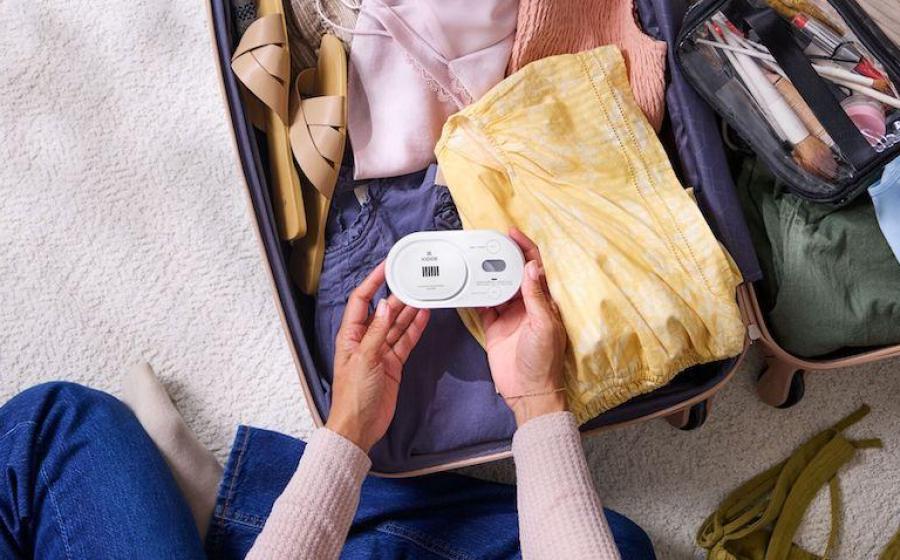
In addition to checking the CO regulations ahead of a trip, travelers can also consider packing a portable carbon monoxide alarm, such as Kidde’s AA Battery-Powered Carbon Monoxide Alarm3, which features low-level alerts in certain models designed to help provide early warning and peace of mind while traveling. 

Depending on the model, features can include:

• Easy-to-read alerts: A backlit display on select models can light up with the push of a button, making it easier to check the alarm day or night.

• Fewer nighttime interruptions: Travelers can enjoy features designed to help avoid being disturbed by alerts that aren't critical during nighttime hours.

• Long-lasting battery power: Kidde AA batteries are designed to last up to a year under normal operating conditions, helping make routine battery replacement easier to remember4.

Travelers should also make sure any portable CO alarm they purchase is listed by a Nationally Recognized Testing Laboratory (NRTL). Look for an ETL Listed or UL Listed Mark on the packaging or back of the device. These marks indicate that the product has been independently tested and listed to meet specific safety performance standards.

Whether the trip involves a weekend road trip or a longer family vacation, be sure to make safety a part of the packing list, as it can help travelers head out with greater confidence and peace of mind. 

Important Product Information: Kidde portable carbon monoxide alarms are not approved for RV or boat use. Pack carefully to help avoid damage to the device. Remove batteries prior to travel and reinsert upon arrival. For use in conditioned spaces only. Test the device before use to ensure proper operation.

1 Based on total household installations as of December 2023.

2 Children, elderly adults and pets are more vulnerable to low levels of carbon monoxide and may be affected faster.

3 Children, elderly adults and pets are more vulnerable to low levels of carbon monoxide and may be affected faster.

4 Under normal operating conditions. Check User Guide for additional details on battery replacement.

Subscribe to Travel